> ## Documentation Index
> Fetch the complete documentation index at: https://docs.ardor.cloud/llms.txt
> Use this file to discover all available pages before exploring further.
# MCP Servers
> Connect Model Context Protocol servers to Cerebrum and use their tools, resources, prompts, and interactive apps.
MCP servers let Cerebrum work with external tools and data sources through the Model Context Protocol. After you connect a server, its tools, resources, prompts, and supported MCP Apps become available in your agent conversations.
Use MCP when you want Cerebrum to work with systems outside Ardor, such as internal databases, analytics tools, documentation stores, issue trackers, or specialized product tools.
## Connect MCP with Cerebrum
The recommended way to connect an MCP server is to ask Cerebrum in chat. Describe the server you want to add, and the agent will guide you through the required details.
MCP connections are personal to your Ardor account. Once connected and enabled, the server becomes available to your agent sessions.
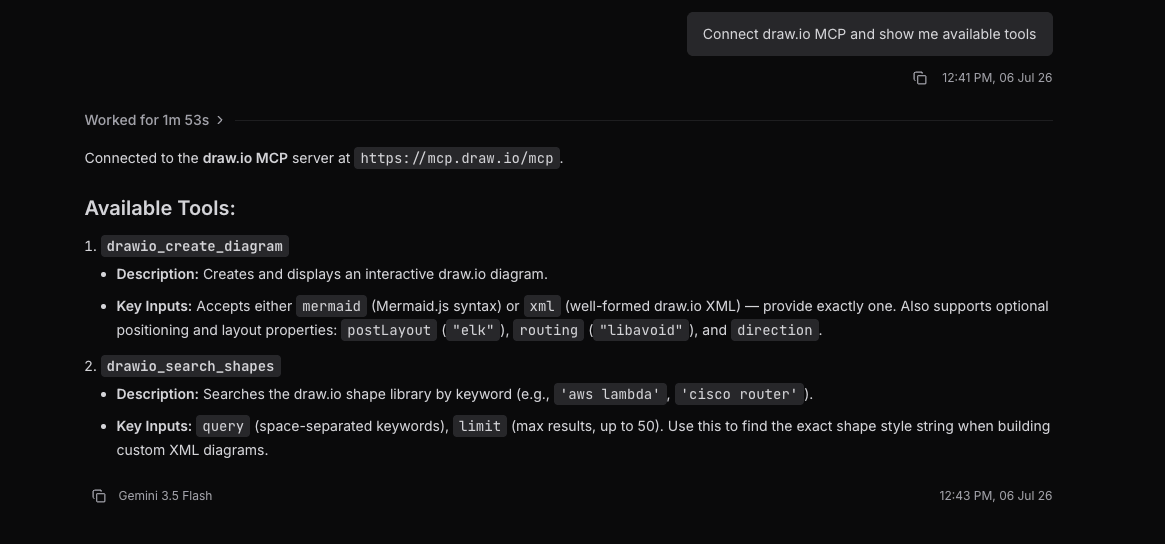 Start with a message such as "Connect our Jira MCP server", "Add an MCP server for Metabase", or "Help me set up this MCP endpoint."
Cerebrum may ask for the server URL, namespace, transport, and authentication method.
If the server uses OAuth, follow the authorization link. If it uses a token or custom headers, provide the credentials when Cerebrum asks for them.
Cerebrum checks the connection and reads the available tools, resources, and prompts.
Ask the agent to use the new MCP server in the same conversation.
Examples:
* "Connect an MCP server named `docs` at `https://mcp.example.com` using Streamable HTTP."
* "Add our analytics MCP server. It uses OAuth."
* "Set up a Jira MCP connection with bearer token authentication."
* "Check whether the new MCP server exposes prompts or resources."
Keep namespaces short and recognizable. For example, use `docs`, `jira`, `metabase`, or another label that matches the system behind the MCP server.
### Connection Fields
| Field | What it means |
| ---------- | -------------------------------------------------------------------------------------------------- |
| Name | A readable label for the connection in settings. |
| Namespace | A short prefix Ardor uses to distinguish this server's tools and resources from other MCP servers. |
| Server URL | The URL of the remote MCP server. |
| Transport | The protocol used to connect. Ardor supports Streamable HTTP and SSE. |
| Auth | The authentication method for this server: none, bearer token, custom headers, or OAuth. |
## Use MCP in Chat
Once a connection is enabled, Cerebrum can use its MCP tools while you talk to the agent. You can ask in plain language; you do not need to call the tool manually.
Examples:
* "Use our docs MCP server to find the latest onboarding guide and summarize it."
* "Check the analytics MCP server for yesterday's signup count."
* "Create a Jira issue for the bug we just discussed."
* "Read the customer record from the CRM MCP server and explain the renewal risk."
When Cerebrum decides an MCP tool is useful, it calls the tool, reads the result, and continues the conversation with that result in context. If the tool requires arguments, Cerebrum prepares them from your request and the current conversation.
### Reference MCP Resources
Some MCP servers expose resources, such as documents, schemas, saved queries, dashboards, or records. You can reference these resources from the chat composer with `@`, the same way you reference Ardor objects.
Open the reference picker in the chat composer.
Select the MCP resource group and pick the resource you want Cerebrum to inspect.
Send a message such as "Explain this resource", "Use this as context", or "Compare this with the current implementation."
### Use MCP Prompts
If an MCP server exposes prompts, they appear in the slash command picker.
Open slash commands in the chat composer.
Choose a prompt from the **MCP prompts** section.
If the prompt requires arguments, Cerebrum inserts a template telling you what to provide.
MCP prompts are useful for reusable workflows owned by the external system, such as support triage, query generation, incident review, or domain-specific analysis.
## Use MCP Apps in the UI
Some MCP tools can return an interactive MCP App instead of only text. When this happens, Ardor shows an **MCP App** card directly in the chat.
An MCP App can be a dashboard, picker, editor, visualization, form, or another small interface supplied by the MCP server. You can interact with it without leaving the agent session.
Ask Cerebrum for a task that the connected MCP server supports, such as exploring a dashboard, choosing records, or working with a visual query tool.
The tool returns an MCP App resource. Ardor detects it and renders an **MCP App** card in the conversation.
Click, filter, select, edit, or inspect the embedded interface.
If the app sends a message or updates its model context, Cerebrum can continue from the current UI state.
MCP Apps can explicitly share UI state, such as selected records or filters, back to the chat session. If the agent does not understand what you selected, describe it in your next message or ask the app to apply the current selection if it supports that action.
## Manage MCP in Settings
The MCP settings page is a reference and management surface. Use it when you want to inspect existing connections or make a direct change without asking the agent.
Go to **Settings** -> **Account** -> **MCP Servers** to see each connection's status, auth type, available tools, resources, prompts, and enabled state.
Start with a message such as "Connect our Jira MCP server", "Add an MCP server for Metabase", or "Help me set up this MCP endpoint."
Cerebrum may ask for the server URL, namespace, transport, and authentication method.
If the server uses OAuth, follow the authorization link. If it uses a token or custom headers, provide the credentials when Cerebrum asks for them.
Cerebrum checks the connection and reads the available tools, resources, and prompts.
Ask the agent to use the new MCP server in the same conversation.
Examples:
* "Connect an MCP server named `docs` at `https://mcp.example.com` using Streamable HTTP."
* "Add our analytics MCP server. It uses OAuth."
* "Set up a Jira MCP connection with bearer token authentication."
* "Check whether the new MCP server exposes prompts or resources."
Keep namespaces short and recognizable. For example, use `docs`, `jira`, `metabase`, or another label that matches the system behind the MCP server.
### Connection Fields
| Field | What it means |
| ---------- | -------------------------------------------------------------------------------------------------- |
| Name | A readable label for the connection in settings. |
| Namespace | A short prefix Ardor uses to distinguish this server's tools and resources from other MCP servers. |
| Server URL | The URL of the remote MCP server. |
| Transport | The protocol used to connect. Ardor supports Streamable HTTP and SSE. |
| Auth | The authentication method for this server: none, bearer token, custom headers, or OAuth. |
## Use MCP in Chat
Once a connection is enabled, Cerebrum can use its MCP tools while you talk to the agent. You can ask in plain language; you do not need to call the tool manually.
Examples:
* "Use our docs MCP server to find the latest onboarding guide and summarize it."
* "Check the analytics MCP server for yesterday's signup count."
* "Create a Jira issue for the bug we just discussed."
* "Read the customer record from the CRM MCP server and explain the renewal risk."
When Cerebrum decides an MCP tool is useful, it calls the tool, reads the result, and continues the conversation with that result in context. If the tool requires arguments, Cerebrum prepares them from your request and the current conversation.
### Reference MCP Resources
Some MCP servers expose resources, such as documents, schemas, saved queries, dashboards, or records. You can reference these resources from the chat composer with `@`, the same way you reference Ardor objects.
Open the reference picker in the chat composer.
Select the MCP resource group and pick the resource you want Cerebrum to inspect.
Send a message such as "Explain this resource", "Use this as context", or "Compare this with the current implementation."
### Use MCP Prompts
If an MCP server exposes prompts, they appear in the slash command picker.
Open slash commands in the chat composer.
Choose a prompt from the **MCP prompts** section.
If the prompt requires arguments, Cerebrum inserts a template telling you what to provide.
MCP prompts are useful for reusable workflows owned by the external system, such as support triage, query generation, incident review, or domain-specific analysis.
## Use MCP Apps in the UI
Some MCP tools can return an interactive MCP App instead of only text. When this happens, Ardor shows an **MCP App** card directly in the chat.
An MCP App can be a dashboard, picker, editor, visualization, form, or another small interface supplied by the MCP server. You can interact with it without leaving the agent session.
Ask Cerebrum for a task that the connected MCP server supports, such as exploring a dashboard, choosing records, or working with a visual query tool.
The tool returns an MCP App resource. Ardor detects it and renders an **MCP App** card in the conversation.
Click, filter, select, edit, or inspect the embedded interface.
If the app sends a message or updates its model context, Cerebrum can continue from the current UI state.
MCP Apps can explicitly share UI state, such as selected records or filters, back to the chat session. If the agent does not understand what you selected, describe it in your next message or ask the app to apply the current selection if it supports that action.
## Manage MCP in Settings
The MCP settings page is a reference and management surface. Use it when you want to inspect existing connections or make a direct change without asking the agent.
Go to **Settings** -> **Account** -> **MCP Servers** to see each connection's status, auth type, available tools, resources, prompts, and enabled state.
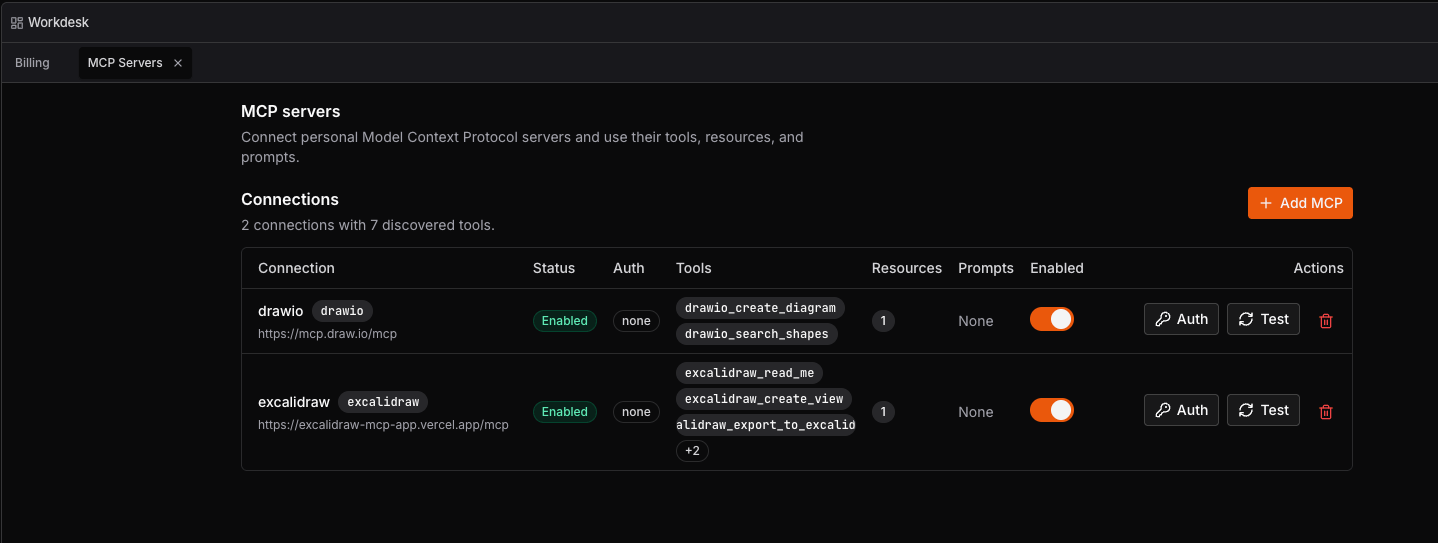 You can also add a server from this page, but the recommended flow is still to ask Cerebrum to connect it for you.
### Add a Server Manually
Go to **Settings** -> **Account** -> **MCP Servers**.
Click **Add MCP**.
Add a name, server URL, namespace, transport, and authentication method.
For no-auth, bearer token, or custom header connections, click **Connect MCP**. For OAuth connections, click **Continue to OAuth** and complete the authorization flow.
Use **Test** to refresh the server catalog and confirm that Ardor can read its available tools, resources, and prompts.
### Connection Actions
| Action | Use it when |
| -------------- | ----------------------------------------------------------------------------------------- |
| Enabled switch | Temporarily hide or restore a server for agent runs. |
| Auth | Update bearer token or custom header credentials. |
| Authorize | Complete or refresh OAuth authorization. |
| Test | Refresh the server catalog and check whether tools, resources, and prompts are reachable. |
| Delete | Remove the connection and stored credentials from your account. |
Disabling or deleting an MCP server stops future agent runs from using its tools. Existing chat messages remain in the conversation history.
## Troubleshooting
Ask Cerebrum to check the MCP connection. You can also open **Settings** -> **Account** -> **MCP Servers**, confirm that the connection is enabled, and click **Test**.
Ask Cerebrum to re-authorize the connection. You can also use **Authorize** for OAuth servers, or **Auth** for token and custom header based servers.
Mention the server namespace in your request, or reference an MCP resource from the `@` picker so the agent has a clear target.
The app resource may be unavailable, the server may have returned an error, or the app may require authorization. Test the connection and update credentials if needed.
Ask the app to send or apply the current selection if it has that control. Otherwise, describe the selection in your next message.
You can also add a server from this page, but the recommended flow is still to ask Cerebrum to connect it for you.
### Add a Server Manually
Go to **Settings** -> **Account** -> **MCP Servers**.
Click **Add MCP**.
Add a name, server URL, namespace, transport, and authentication method.
For no-auth, bearer token, or custom header connections, click **Connect MCP**. For OAuth connections, click **Continue to OAuth** and complete the authorization flow.
Use **Test** to refresh the server catalog and confirm that Ardor can read its available tools, resources, and prompts.
### Connection Actions
| Action | Use it when |
| -------------- | ----------------------------------------------------------------------------------------- |
| Enabled switch | Temporarily hide or restore a server for agent runs. |
| Auth | Update bearer token or custom header credentials. |
| Authorize | Complete or refresh OAuth authorization. |
| Test | Refresh the server catalog and check whether tools, resources, and prompts are reachable. |
| Delete | Remove the connection and stored credentials from your account. |
Disabling or deleting an MCP server stops future agent runs from using its tools. Existing chat messages remain in the conversation history.
## Troubleshooting
Ask Cerebrum to check the MCP connection. You can also open **Settings** -> **Account** -> **MCP Servers**, confirm that the connection is enabled, and click **Test**.
Ask Cerebrum to re-authorize the connection. You can also use **Authorize** for OAuth servers, or **Auth** for token and custom header based servers.
Mention the server namespace in your request, or reference an MCP resource from the `@` picker so the agent has a clear target.
The app resource may be unavailable, the server may have returned an error, or the app may require authorization. Test the connection and update credentials if needed.
Ask the app to send or apply the current selection if it has that control. Otherwise, describe the selection in your next message.